
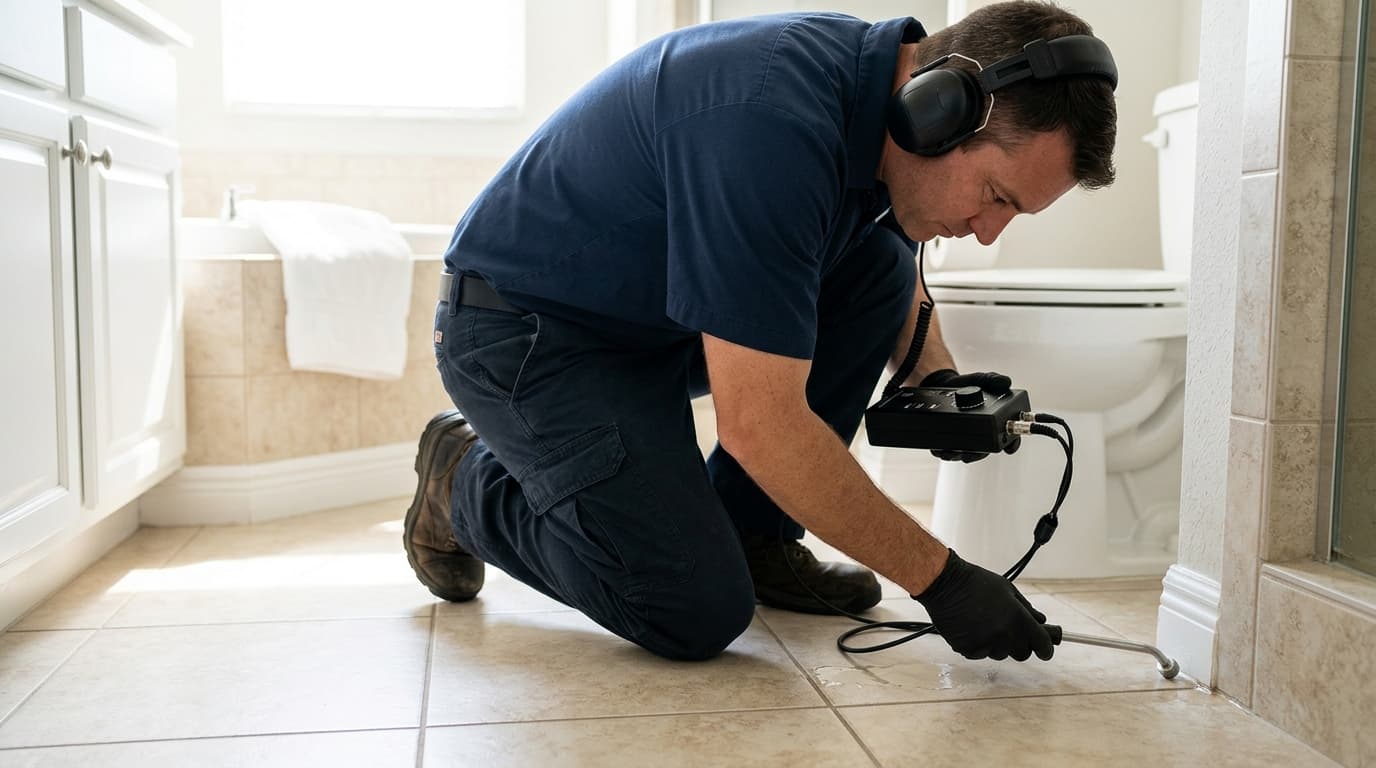
Most Florida homes are built on a concrete slab, with supply and drain lines running underneath it. When one of those lines develops a leak, there's no dramatic puddle in most cases — just a set of quieter signs that are easy to write off as something else, until the water bill arrives.
The signs that actually point to a slab leak
An unexplained jump in your water bill. This is the most reliable early indicator. If your usage habits haven't changed but your bill has climbed noticeably, that's worth investigating before anything else.
A warm or damp spot on an otherwise dry floor. If the leak is on a hot water line, you may notice one area of flooring feels warmer than the rest — sometimes enough to feel through socks.
The sound of running water with everything off. Stand in a quiet room, make sure no fixtures or appliances are running, and listen. A hissing or trickling sound near the floor is a real signal.
Your water meter still moving. Turn off every fixture and appliance in the house, then check your water meter. If the small leak-indicator dial is still spinning, water is flowing somewhere.
Mold or musty smell with no obvious source. Moisture trapped under flooring can create a persistent musty smell well before any visible sign of water.
Cracks in flooring or baseboards separating from the wall. In more advanced cases, sustained water under a slab can cause subtle shifting.
A simple test you can run yourself
- Locate your water meter.
- Make sure every fixture, appliance, ice maker, and irrigation zone is off.
- Note the reading, including the small leak-indicator dial if your meter has one.
- Wait 1–2 hours without using any water.
- Check the meter again.
If the reading has moved — especially if the leak-indicator dial spun at all — there's a strong chance you have a leak somewhere in the system, though this test alone can't tell you if it's under the slab specifically versus elsewhere in the yard or house.
Why guessing at the location is a bad idea
Once a leak is confirmed, the temptation is to start guessing and cutting into the slab to find it. That's expensive, disruptive, and often wrong. Professional leak detection uses acoustic equipment that listens for the specific sound signature of pressurized water escaping, plus thermal imaging that can show a hot-water line leak as a temperature difference on the surface — both without any demolition to search.
What happens after it's found
Once pinpointed to within a few inches, you typically have two paths: a targeted spot repair through a small access point in the slab, or in some cases rerouting the affected line above the slab entirely to avoid disturbing the foundation again. We'll walk through both options and the real cost difference before you decide.
If your water bill has jumped and you can't find an obvious cause, don't wait — a confirmed slab leak only gets more expensive to ignore.