
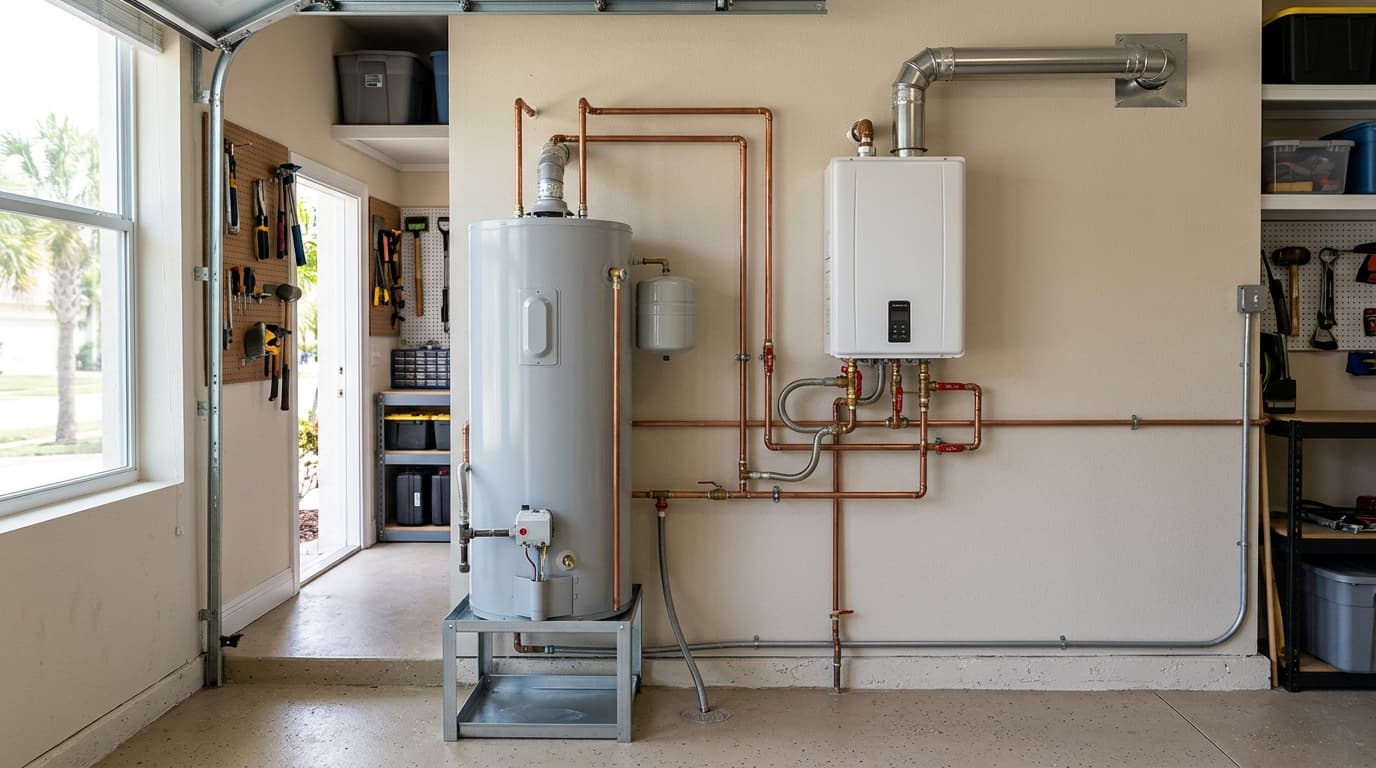
Every water heater eventually needs replacing, and when that day comes, most Florida homeowners land on the same question: stick with a traditional tank, or switch to tankless? There's no universally correct answer — it depends on your household, your budget, and how you actually use hot water.
How they're different
A tank water heater keeps 40–50 gallons of water heated and ready at all times, reheating it continuously to maintain temperature. A tankless water heater heats water on demand as it flows through the unit, with no standing reserve.
The case for tank
Lower upfront cost. A standard tank replacement typically runs $1,400–$2,600 installed — meaningfully less than a tankless conversion in most cases.
Simpler installation. If you're replacing a tank with a tank, the existing venting, gas line, and electrical are usually already sized correctly. It's often a same-day job.
Simpler repairs. Tank systems have fewer components, and most repair parts (thermocouples, heating elements, thermostats) are inexpensive and widely stocked.
Lower failure ceiling. If a tank fails, you get water in the utility closet or garage — not usually flowing water damage across the house (a drain pan and safety switch reduce this risk further).
The case for tankless
Never runs out. This is the big one for larger households or homes with back-to-back showers, a soaking tub, and a washing machine all competing for hot water.
Smaller footprint. Tankless units mount on a wall and free up closet or garage space a tank would otherwise occupy.
Longer lifespan. Well-maintained tankless units often last 15–20 years, compared to 8–12 for a typical tank.
Lower standby energy loss. Because there's no tank of water being continuously reheated, tankless units can reduce energy use for water heating — though the real-world savings depend heavily on usage patterns.
The catch with tankless
Converting from tank to tankless usually isn't a simple swap. It often requires:
- A larger gas line, since tankless units draw more BTUs during operation
- New venting sized for the unit
- Sometimes an electrical upgrade for the ignition system
That extra work is why tankless conversions typically cost more installed than a straight tank replacement, even though the unit itself may not cost dramatically more.
Our honest take
If your household runs 1–3 people with typical hot water use and budget matters most, a tank replacement is usually the practical choice. If you regularly run out of hot water, have a larger household, or are already renovating and dealing with venting and gas lines anyway, tankless is worth the extra investment.
We'll walk through your actual hot water usage — not a generic script — and give you a straight recommendation, including the real installed cost for your specific home's gas line and venting situation before you decide.